Total Pageviews

Showing posts with label pacific. Show all posts

Saturday, April 16, 2016

Tamera's Take: A Day In The Life, Cats & Learn Spanish Please

Tamera's Take is about being here.
Are you ready?  I am.

Questions? E-mail us!
Follow us on Twitter - @JOTOinEcuador
Like Us on Facebook!

Quick Links


¿Yo hablo español?  (Do I speak Spanish?)
¿Hablas español?     (Do you speak Spanish?)


"Woke up, fell out of bed
Dragged a comb across my head
Found my way downstairs and drank a cup
And looking up I noticed I was late
Found my coat and grabbed my hat
Made the bus in seconds flat
Found my way upstairs and had a smoke
And somebody spoke and I went into a dream"

This is how my life feels at present.  Sort of stuck riding on a ferris wheel going forward and backward, but always in a circle.

A view of two worlds from the top and a dizzy blur at the bottom.

"A Day In The Life"

The final track on Sgt Pepper's Lonely Hearts Club Band album comprises of two unfinished songs (one by John Lennon, one by Paul McCartney) bridged together by an orchestral arrangement.

I could use some of those orchestral arrangements about now.  Where are The Beatles when you need them?!

Look Closely.  Crucita!!


There has not been a time in my life that I did not dream about traveling the world.  

Even in Kindergarten.  Seriously.  

My mother began teaching me to read when I was three. She loved to read.  Books have always been an important part of my life.  

We would go to the library every two weeks to check out books.  Well, my mother would check out the books.  Some for herself, some for me.  

By the time I was in second grade the librarian gave me my own library card.  Reading a book was like going to some exotic place.  Exotic places where I really could not go.  I was just a kid.  

But one day I would go.  Maybe.  Hopefully.


A small village in the Andes mountains, Ecuador; and a page from my favorite childhood book.

Rock Music in Ecuador! Bridging my worlds together.
The first time I truly realized that not everyone spoke only English was the announcement of a school trip to Paris France.  I think I was twelve years old.

The students who could afford to go would spend the first seven months of the school year attending a special class to learn French.  Of course I did not get to go.  My family could not afford it.  My parents thought I was too young for such a trip anyway.

One of my good friends went.  I begged her to teach me the French she was learning.  She taught me a few phrases.  I still remember how to say them perfectly.  However, I cannot write or spell them to save my life.

What is my point? I am coming around to it.  I promise.

There were no other opportunities for me to learn other languages until I started high school.  At fourteen years old, the trip to France (that I did not take) now a distant memory, I signed up to take Beginning Spanish.

A little surreal wall art in Canoa, Ecuador.
Let me rush along this mini-biography by telling you that I took three years of Spanish.  As I started my second year of Spanish, I also started taking my first year of German. As I started my third and final year of Spanish, I also started my second year of German.  A third year of German was not offered unfortunately.

Now, I bet you are thinking, "Wow, she knows three languages."

You would be wrong.

I know English.

I studied grammatical Spanish and German.

This is not the same as speaking Spanish and German.  I can conjugate the heck out of those foreign verbs.  I can tell you which nouns are masculine or feminine.  I know the names of those special characters and how to pronounce the words that contain them.  I can read both languages well enough to decipher most print material.

A view from the top of the ferris wheel!

None of that will help you when you are at the checkout in a grocery store and the clerk is asking you a question in what seems like lightning speed.  It sounds nothing like what you heard in that classroom for three years.  You have no idea how to begin to respond. But you have to. So you say something in your best "Americanized Spanish".  The clerk stares at you blankly, having no idea what you just said.

The blur at the bottom of the ferris wheel!

I would not walk into any of these stores without knowing some Spanish.
One of the reasons we are writing this blog is to help others who are planning or may be planning to come to Ecuador.

Here is my advice.

If you are planning on living in Ecuador for an extended period of time, take the time to learn some conversational Spanish.  

I cannot stress this enough.

Thank goodness for Penguino!  This is the town of Puerto Cayo.
The reason I say this is not because the number of Ecuadorians who speak English is low.  I say this because the official language is Spanish.  Ecuador is in South America, not Europe.  I am overstating the obvious but it needs to be said.  Most Europeans can speak multiple languages.

Central and South America is predominantly Spanish speaking.  North America is predominantly English speaking.  It took a while to achieve this - the homogenization and decimation of the many diverse languages that used to exist on these continents, down to two basic languages.

But what was done cannot be reversed.  With such large populations speaking the same language, I suppose the need to learn another language does not seem necessary in the grand scheme of daily life.

Unless you want to go somewhere and interact with people who do not speak your language.

Crucita.  West to the Pacific Ocean.  East to the Andes Mountains.

Make no mistake.  We have learned to speak a lot of Spanish since we arrived in Crucita.  We got right out there and spoke with our neighbors, shops owners, etc.  We did our Rosetta Stone lessons.  I put little green Post It Notes all over the kitchen with words and phrases to help us remember.  I work hard at it.  Jason and I both do.

There are days when it is exhausting and I simply do not have the energy to try to speak another language.  There are days when it is exhilarating because I am able to carry on a conversation with someone in Spanish.

So what is my point?
LEARN SPANISH!

My point is that after all these years, I have finally traveled to another part of the world.

Because I arrived barely able to speak the language, there are many days when I am not getting all that I should be out of this experience.

This is a very recent realization. A very frustrating realization.

Knowing conversational Spanish would be one of those orchestral arrangements that will make the difference between a spectator and being a participant.  

You guys need to learn Spanish.
I will keep working on it.  A few nights ago, I actually had a dream in Spanish!  I guess it is time to get off the ferris wheel.

In case you were wondering.

Catspeak is the same in any country.


Questions? E-mail us!
Follow us on Twitter - @JOTOinEcuador
Like Us on Facebook!

Quick Links

Like what you see?  Please take a moment to easily share it with your friends using the toolbar below.  Thank you!


Thursday, December 24, 2015

Tamera's Take: Gilligan's Island, Cats and Holidays

Tamera's Take is about being here.
Are you ready?  I am.

One day in a public speaking class at NYU, the professor had students compose an impromptu one-minute speech on this topic:  If you were stranded on a desert island, what one item would you like to have?  Sherwood Schwartz was a student in that class, and the question so intrigued him that it remained lodged in the back of his mind for many years.

Who is Sherwood Schwartz?  Sherwood Schwartz was a famed television producer and Emmy Award winning screenwriter, best known for Gilligan's Island and The Brady Bunch.

Bamboo House

I grew up with both of those shows.  With the exception of the "Hawaii Bound" episode, The Brady Bunch has nothing to do with being in Ecuador - nothing that I can think of anyway.   On the other hand, Gilligan's Island seems pretty close to home.
Ecuador and Jacksonville are on the same Longitude

We are not stranded on a deserted island.  But at times it feels like we are on an island.

As I have mentioned in my previous posts, to the North, East and South of Crucita is a crescent of mountains.  The village of Crucita is directly on the Pacific coast, and the adjacent farms are located between the village and the mountains.

The entire area is very tropical, even the farm-land.  The coconut trees are endless.

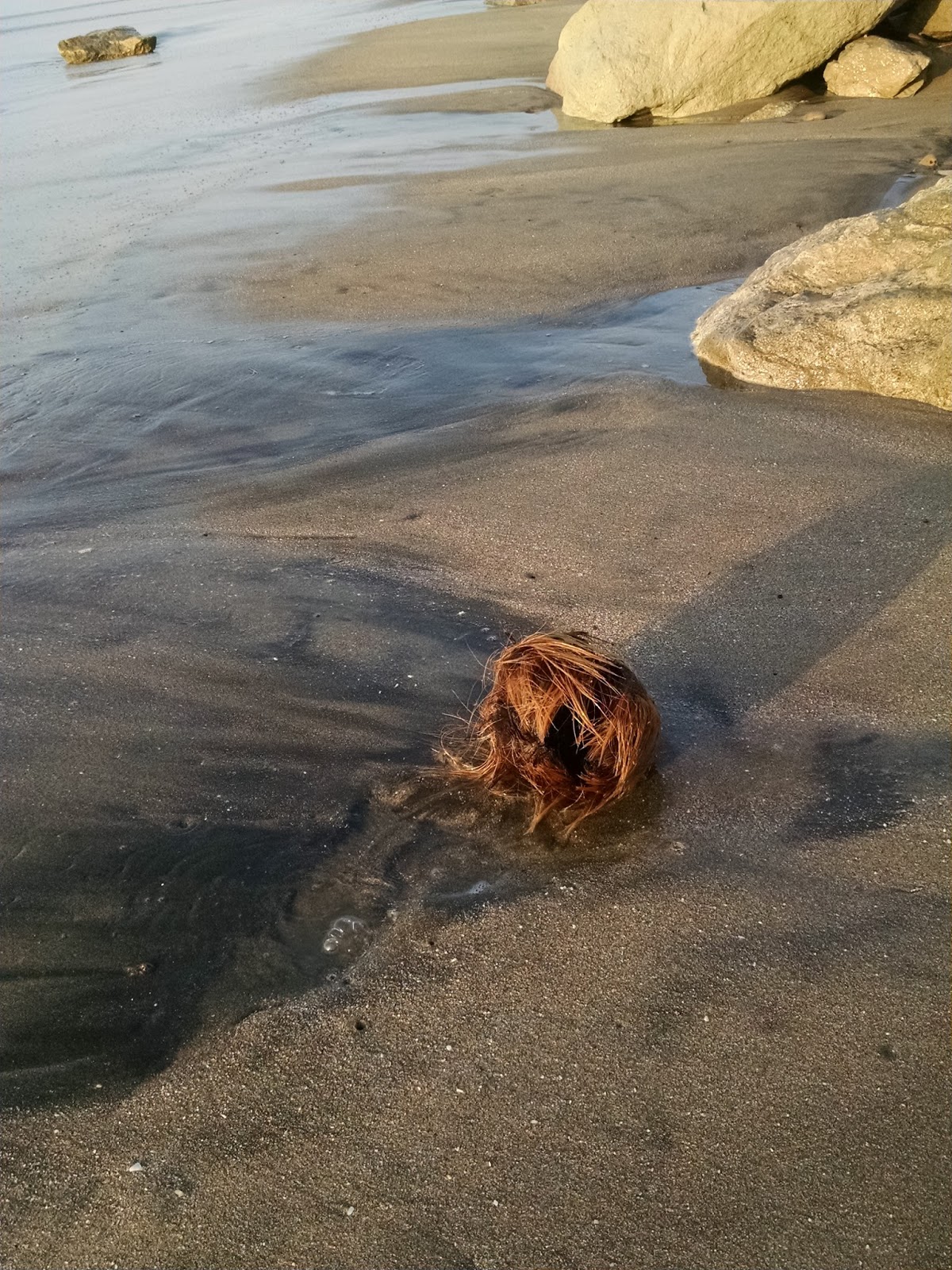
Ecuadorians drink Agua de Coco (in the U.S. we call it coconut milk) directly from coconuts with a straw, then scoop out the coconut with a spoon. Restaurants simply cut off the top of a coconut with the husk on, then in goes the straw.  Cold agua de coco is sold by the bag.


Watch out for falling coconuts!

When I was a kid I remember bugging my mom over and over until she finally relented and bought me a coconut from the grocery store.

For those of you who were in Jacksonville during the 1970's, you may remember a store called Pantry Pride.

It had already been shelled from the husk.  I had no idea how to open it.  This was not going to deter me.  I took a hammer and screwdriver from my dad's work bench, and began the task of beating this poor coconut.

My goal was to puncture a hole so I could get the coconut milk first.

This did not go well, for me or the coconut.


Many varieties of Bamboo (Caña de Bambu) are grown here in abundance and used by almost every family, in one way or another.  Caña is used to make furniture, fishing rods, fences, and even houses. There are many uses for coconuts in addition to a source of food and beverage.  Coconut husk is a fiber that can be used to make rope, rugs and fabric.  Coconut shells are a source of charcoal and can be burned as fuel.  They can also be used to send messages.

JFK used this as a paperweight on his desk in the Oval Office. 

In a dugout canoe, Biuku Gasa and Eroni Kumana of the Solomon Islands, located the U.S. crew of PT-109 on August 5, 1943.  The crew had been stranded for three days on an inhabited island of the South Pacific after being hit by an enemy destroyer, and presumed dead.  In command of that crew was Lt. John F. Kennedy.

Kumana and Gasa worked with the Coastwatchers, a network of agents based across the Pacific islands during WWII, tasked with keeping an eye on the enemy and reporting back to Allied forces.
Kennedy knew he somehow needed to get a message back to base if a rescue was to be organised, so he wrote a message on a coconut and gave it to Kumana and Gasa to return to a Coastwatchers station 35 miles (55 km) away.


Paper Stars
Tonight is Christmas Eve.

This is our first Christmas in Ecuador.  This means we will not be able to spend the holidays with our family and friends back in the states.  I know this is not easy for them. It is not easy for us.

We did our Christmas shopping online for the family, made phone calls through Skype Phone, and plan to video call our family tonight through Skype on our laptop.

Most of our neighbors have decorated artificial Christmas trees.  Next to their trees, they set up very beautiful Nativity scenes.  We do not have a Christmas tree or a Nativity scene.  After two trips to the Hipermarket last week, we still could not find any Christmas lights.  I was resolved to have some type of decorations, knowing that I would plan better for next year.


We have paper stars all over the second floor of our house.  It looks more like Cinco de Mayo than Christmas, but decorations are decorations.

Two days ago, after I made all those paper stars, we found lights (luces) in the little tienda around the corner from our house. They had decorations too. But those colorful paper stars have started to grow on me.

At least now we know where to buy lights and decorations.

Fiesta de Navidad!
As I am writing this I can hear a lot of festive music, including music I recognize from the states. The children have a holiday from school - today and tomorrow.  There are little parties being held all throughout the neighborhood.

Christmas Eve is when Ecuadorians celebrate Christmas.  The families gather all day for festivities, then open their presents at midnight.

I am not sure what will happen on Christmas Day.  I will find out tomorrow.


Jason and I were lucky enough to be part of a Christmas party on December 21.  Our friend Tamy and her husband Jared have a Fiesta de Navidad at their home for the children of the farmers in her parish - just outside the town of Portoviejo.  Tamy raises money and organizes this event every year by herself, and on the day of the fiesta (party) family and friends volunteer to help.  There was a lot of work involved.

Feliz Navidad!
Many of these children will not receive any presents on Christmas, except for the ones they received at this party.

There were over 250 children attending the party, along with a very entertaining clown who also acted as the MC (master of ceremonies),  Santa Claus, and the very famous well-loved Peppa Pig & his brother George!

Volunteering at this party was probably the best Christmas present we could have received.

Well, it is time for me to bake some cookies.

To all of our friends, family, and to everyone else who reads our blog,

Merry Christmas & Feliz Navidad!


Good Kittie!
Kodak gets his Christmas bath!  

Questions? E-mail us!

Like what you see?  Please take a moment to easily share it with your friends using the toolbar below.  Thank you!

Monday, November 30, 2015

Tamera's Take: Cast Away, Cats and Blue Bottle Diablos


I would first like to say !Bienvenidos! (welcome) to our new readers in Ecuador, Ukraine, Germany, Romania and the United Kingdom.

Tamera's Take is about being here.
Are you ready?  I am.

In the beginning, we considered going the shipping container route to bring most of our belongings.  Then we considered airline cargo (basically a lot of checked luggage) to bring some of our belongings.  In the end there were just too many complications with trying to bring all that stuff.

Some things we gave away to family
If you read my husband Jason's most recent post, Familia y Los Amigos - They Love You.  Always and Forever, then you know that we sold or gave away almost everything we owned in order to move to Ecuador.

We arrived in Ecuador with four checked bags weighing a total of 200 pounds, and four carry-on bags consisting of a laptop bag, a small suitcase on wheels, and two carry on pet carriers containing two cats each.

Yes we traveled with pets.  Four pets to be exact - in case you did not do the math.

We rented a fully furnished house about 75 yards (68 metres) from the beach.   Except for a toaster and a frying pan, the house has everything needed.


I think you get the picture.  No.  Not that picture.  The other one.

Yes we brought our CATS!!

There will be a future post on container shipping, air cargo, what we brought and what we wish we had brought.

I will mention one item I wish we had brought. Benedryl.

Sea Glass
Something I notice, now that I live so close to the beach (playa), is the array of things that I find on the shore.

Some things discarded by the many fisherman as they sort out their catch, some things that come directly from the ocean, and some things that wash up with the tides from another place.


My home state of Florida has nearly 1200 miles of coastline, surrounded by the Atlantic Ocean, Gulf of Mexico and the Florida Straits.


Drift wood? Drift tree!


This is not a geography lesson.

Treasure hunters with their metal detectors, beach combers picking up shells, sea glass, drift wood, conservationist protecting sea turtle nests and native plants of the dunes; these sights are second nature to me.  Just like spending summers at my grandmother's beach cottage in St. Augustine, going to Anastasia Park with friends as a teenager and as an adult taking my own daughter to the these beaches.

But I never lived at the beach.  Never lived anywhere with the shore and the ocean just steps away from my front door.


A lot of things get discarded in a natural process or otherwise.


Fishermen discard some things

Some things make that transition from shore to ocean and back to the shore again.  Maybe not the same shore, but a shore.  Somewhere.

I learned from an early age to keep an eye out for one of those things that wash up on shore in the natural process - jellyfish.  Why?  Because if jellyfish are on the shore, you can bet they are in the water close to the shore.

If you have never experienced a jellyfish sting, I am glad.


I was not so lucky.  It is inevitable when you spend so much time at the beach.  No matter how well you checked out the shore before you got into the water.  As a kid though, you are sometimes willing to take that risk.

Little Sting Ray

I have not been stung by a jellyfish since I was a child.  I suppose I learned my lesson.  I still scan the shore before I jump into the ocean.

That did not matter two days ago.  Jason and I went down to the beach for the specific purpose of swimming in the ocean.
I bugged him about it all day.  I really wanted to go swimming.  Even though Jason was a bit tired - we had both been up since 5:00 am and he had been very busy all day - he recognized that pouting face of mine and with a smile, took me down to the beach to go swimming.

That is what you do for the person you love.  At least that is the kind of thing my husband does for me.  All the time.  He do what he do.


I think I had been in the surf for about one minute when it happened.  Really.  One minute.

Photo by Vlad Minin                              Courtesy of National Geographic
As I swung my left arm behind me to get past the next wave swell coming up, I feel something brush up against me.  My upper left arm.  I stop swimming immediately and float, trying to figure out if a fish or sting ray had nudged me.  Right at that moment, there was pain.  "No a shark."  I say to myself.  Again pain.  This time on my right arm, although, I look to my left because the pain has not stopped there.  I just know what I am going to see.  Instead, I see something else.  It is blue and very small.  Floating just below the surface of the water.  Maybe three inches below the water.  It was about 1 inch in size.  It.

Now the pain has completely surrounded my upper body and my mind goes back to the shark idea.  Completely confused and suddenly frozen, I say to Jason, "something just bit me".  He says to me, "get out of the water".  Not panicked but concerned.  I can see it in his face.

I cannot move.  Not out of fear.  I am just unable to move.  I realize that there is something wrapped completely around me.  Fishing line?  Uh no.  Not fishing line.  Clear and stringy though.

This hurt. A lot.
Excruciating pain.  Jason realizes that I cannot move.  I am not even sure if he is saying anything to me now.  I sort of get mad.  Not at Jason.  But at whatever just bit me and is still trying to bite me.

Meanwhile in the back of my mind, "It was a jellyfish.  But, it was blue.  Jellyfish are not blue.  At least not the ones I know of.  I scanned the shore.  I know I did."


I realize I am being dragged back to shore by Jason.  Then I am being washed up on the shore by a wave. I am in the sand.  Grateful for the rough sand.

"What was it?"  Jason says.

"It was BLUE!"  I say.  Barely able to speak and still grateful for the rough sand.  A blue devil is what I think to myself.  Lucky for me, we are only steps from our front door.  It felt like a mile.  As soon as we get home, Jason starts to apply a series of remedies that most everyone who grows up near the ocean knows.
1. Remove stingers (tentacles).
2. Rinse the affected area with vinegar.

The stingers were pretty much already gone.  Probably into my skin.  So we moved to step two.  Vinegar.  That does nothing to help.  Jason gets on the internet to look up remedies.  We are in Ecuador, not Florida.  Maybe there is something else that we should be doing.  As I am heading upstairs to start step three of the remedies;
3. Shower in hot water.

Jason asks me what they (IT) looked like.  I say, "It was BLUE and very small".  (Except for that long stringy thing that wrapped around me about one hundred times.  Okay.  It was just once but it felt like one hundred.

Step number three helps a little.  I come back downstairs and Jason is looking up "blue jellyfish in Ecuador".  Meanwhile I move to the last step of remedies that we know.
4. Take an over the counter pain reliever.
 
A little better on day two
I swear the pain is actually getting worse. Jason finds a number of pictures and websites (a lot of blogs) that show or discuss this horrible blue jelly creature.  National Geographic website had the most in depth information.

Not a jellyfish.  A Portuguese Man o' War.

Affectionately known in South America (and Australia) as a, "Bluebottle". That is what it was.

A Bluebottle.

BlueBottle Diablo is a better description.

Remember that Benedryl I mentioned earlier?  Apparently vinegar does nothing but make the stinger release more venom.  Anti-allergy medication is what I needed.

You can get Benedryl in Ecuador.

You just can not get it at that moment.  The moment you need it the most.  The moment when you think you have never felt this much pain in all your life.  Of course this is not true.  It just feels that way at the time.

So now we have the remedy checklist.
1. Remove stingers (tentacles)  Check!
2. Hot shower  Check!
3. Anti-allergy medication - like Benedryl  Check!

If I ever get stung again, I am ready.

Ready or not, I hope I never, ever, ever, ever, ever, get ATTACKED by one of those Blue Bottle (diablos) again.

Never.
Wilson!!!
Questions? E-mail us!

Like what you see?  Please take a moment to easily share it with your friends using the toolbar below.  Thank you!


Saturday, November 28, 2015

Tamera's Take: Strange Trees, Cats and Rose Colored Glasses

Tamera's Take is about being here.
Are you ready?  I am.

The ancient Maya of South America believed that a great Ceiba tree stood at the center of the earth, connecting the terrestrial world to the spirit-world above.  The long thick vines hanging down from its spreading limbs provided a connection to the heavens for the souls that ascended them.

The Ceiba tree’s branches were believed by Mayans to act as a seat from which the gods watched the people walking below.

Humans are not separate from nature.

Ceiba Tree facts:
During the dry season the symmetrical flowers can be rather small and inconspicuous at less than 3 cm (1 inch), to showy at more than 12 cm (5 inches); and are usually white, pinkish-white or red, with leathery petals.  This tree has a largely branchless trunk which grows to 60-70 metres (200-230 feet) and buttress roots that can be taller than a grown person.  The deep roots mean it is often one of the few trees left standing after a hurricane.


Borrowed photo. We were riding a bus. 

Thanks to the following websites for the above information:

http://www.fauna-flora.org

http://www.ceiba.org


As I write this, we are currently at the end of the dry season.  There is a bus route from our town of Crucita directly to the city of Portoviejo, about 30 km (18 miles) away.  The buses are scheduled about every 10 minutes, cost $1.10 to ride, and you hail them like a cab.  Equally, when you want to get off, you simply stand up and go to the front of the bus. The bus driver will immediately stop and let you off.

Groceries from Portoviejo
We needed to go to Portoviejo to do some grocery shopping.  We do not have a car, scooter, motorcycle or even a bicycle - yet. There are two options.  A cab or a bus.  A bus it is.

The bus makes a circle around Crucita, on Calle Malecon (coastal road) and Calle Portoviejo.  We are told by our friend Tamy to get on the bus at Calle Malecon, because it will be less crowded.  We are not sure why it will be less crowded, but any advice Tamy gives us is good advice.


It is about 50 yards (45 metres) from our gate to Calle Malecon.

As a side note, during the writing of Tamera's Take, I decide to login and listen to Pandora Internet Radio, only to receive the following message:
Zahi is not amused.

Dear Pandora Visitor,
We are deeply, deeply sorry to say that due to licensing constraints, we can no longer allow access to Pandora for listeners located outside of the U.S., Australia and New Zealand. We will continue to work diligently to realize the vision of a truly global Pandora, but for the time being we are required to restrict its use. We are very sad to have to do this, but there is no other alternative.

This frustrates me, but only for a moment.

Three countries does not sound very global.

I go to the back up plan and play some of our music saved to the laptop.


After all, I am in Crucita.  The sun is shining, the wind is blowing and the waves are crashing on the shore.   This was not the case yesterday.  It was raining on Friday.  Bus Ride Friday.  Black Friday for everyone in the U.S.

[listening to Under the Milky Way by The Church]

Back to Calle Malecon.
Calle Malecon
We are not sure what side of the Calle to catch the bus, but we know that there are no bus stops to search for, no increasingly confusing time schedules to decipher, no bus transfers to make.

Unlike the bus systems in the U.S. and probably many other countries, when we see the bus, just hail it like a cab.  Simple enough.

This is going to be easy.


After standing on the Malecon for about 3 minutes we see a bus heading our way.  Great.  This is going to be easy.  Our arms go up.  The bus stops.  "Este el Autobus a Portoviejo?" I say to the man who opens the bus door (not the driver).  "Portoviejo? Otro... (something something something and I have no idea what)."  Says the man who opens the bus door (not the driver).  However I did catch the word "otro" which means "other".  The man is smiling and pointing to the other side of the street.  Like I said, this is going to be easy.

Views from the bus on the way to Portoviejo 
We cross the street.  Well that was simple anyway.  Wait for it.  Yes.  Here it comes.  Another bus. My husband says, "you put up your arm this time, I did it last time".  I reply, "I held my arm up too". We both laugh and both put up our arms.  Better safe than sorry right?   It worked last time.  It worked this time too.

I should say at this point that "CRUCITA" is painted on the side of the buses.  In the front window is a sign that reads "Portoviejo".

[listening to Yer So Bad by Tom Petty]

The man (not the driver) opens the door.  Portoviejo?  Si.  Good, this is going to be easy.  Then there are those very steep steps.  Only two of them.  But very very steep.  My husband Jason and I are taller than most people here.

Did I mention the bus had really steep steps?

Views from the bus - house for sale
After climbing the steps, the very steep ones, I try to give the man (not the driver) money.  He does not take it.  There is no meter to drop money into.  No place to slide your Metrocard.  Confused for just a moment I keep walking up the aisle looking for two seats together.  Before I know it I am in the back of the bus and I get a look at the passengers for the first time.   All children and teenagers in school uniforms.  For the most part they are sitting in the window seat.  No one in the aisle seats.
Views from the bus - Rice Fields!

Confusion sets back in as I look towards the front of the bus, which is moving. Instinct sets in and we both choose an aisle seat. Did we get on the wrong bus? Did I say this was going to be easy?

The bus stops again and the new passengers are not school children. Feeling a little better by the addition of passengers, who are obviously not coming home from school, I relax.  It is 12:20pm.

We are on our way to Portoviejo.  Us, the school children, the other passengers who are not school children, the man (not the driver), and the driver.  We round the corner and a few more passengers get on the bus.

A man (not the other man or the driver) is walking up the aisle carrying a basket.  What is in the basket?   He is selling something to the passengers.  Fresh baked bread.  Rolls to be exact.  They smell wonderful.  I think about buying one, but decide not to.  I just want to observe for this bus ride.  There are two teenagers sitting behind me.  They are sitting very close together.  The teenage boy buys two rolls, one for himself and one for his girl-friend.

The man (not the driver).  Very nice man. 
The bus stops to let people on and let people off, as buses do.  The school children are quiet or talking very softly.  The other passengers talk socially to each other.  The man (not the driver) walks towards the back of the bus to collect the fare from each passenger.  The children pay a very small fare.  I can not see exactly how much they give him, but it seems to be a few small coins.  Jason and I each give him $1.10, he counts the money and smiles at us and nods.  We got the fare right.

This is nothing like any other bus ride I have taken.  I am actually enjoying it.  I knew it would be easy.

I hear the teenage boy behind me say, "Americanos.  No comprendo."  Of course he meant us.  He was right.

Am I wearing Rose Colored Glasses?  Who can say?!

Maybe I am, maybe not.  I will let you know.

Last Stop


Questions? E-mail us!

Like what you see?  Please take a moment to easily share it with your friends using the toolbar below.  Thank you!